She is an aspiring economist from IPCW, an approachable and amiable person. It would not be wrong to call her a book worm who loves to read and write...
Khadi, a kind of cloth, has never played such a pivotal role in the founding of a country as it has in India’s struggle for independence. In the 1920s, Mahatma Gandhi launched Khadi as a way to help revive India’s cottage industries. He expected that imperial rule could only be overthrown if the economy changed at the time. Since then, Khadi, India’s trademark cloth, with its unending legacies has revolutionized the Indian economy and has thus become a symbol of self-reliance, economic empowerment, and more importantly of Indian pride. In addition it can be a major agent in effectuating realisation of SDGs (Sustainable Development Goals) and in realising humanity’s fight against global warming and climate degradation.
A mandated paradigm shift: Khadi and SDGs
There exists a direct relationship between climate change, economic scarcity, and poverty. The world’s poor are heavily affected by natural disasters as their livelihoods are dependent on economically scant resources. Therefore, necessitating the need to move towards a “green economy”. Such an economy is an endeavor to reduce environmental risk and economic scarcities and aims for sustainable development without degradation. In such a context, with global warming bringing about new challenges to mankind, economists and environmentalists have found Khadi as the way forward towards a sustainable clothing industry. Today the cloth has adapted itself quite well with the industrialized revolution. It is now produced using modern machinery as compared to its earlier manual method of production.
Khadi production is simple, decentralized, energy efficient and inexpensive as its tools of production are easily accessible, chiefly made from wood and bamboo which are renewable and long-lasting and can be manufactured cheaply on a local level. Hence it can emerge as a bold template for empowerment and self reliance which can help in ensuring improved nutritional status of the marginalised women artisans, designers, small workers and MSME (Micro, Small & Medium Enterprises). Also it uses carbon-free, non-petroleum products as its inputs, for instance, a metre of the freedom fabric, khadi, consumes three litres of water, while in contrast one metre of mill-produced fabric requires 55 litres of the precious resource. Thus its production can enable in realising the fifth and eighth Sustainable Development Goal of achieving gender equality and promoting sustained, inclusive and sustainable economic growth, employment and decent work for all. In addition, with its supple nature, it can sprightly catch the attention of foreign investors and will connect grassroots with the global market. Thus swapping it with costly western apparel can act as a key game changer in boosting the Indian economy. To use the words of the Father of the Nation, “Khadi aims to bring power to the grassroots from the top, it is not just merely a piece of cloth but a way of life” (Gandhi 1955).
Hurdles and the way forward:
Today, khadi can be termed as a part of the solution for the major environmental crisis that the world is facing. The revival and rejuvenation of Khadi have found an extended market in India. Khadi-weaving was traditionally the occupation of the economically weaker sections; however, this has changed with the arrival of brands like FabIndia, Nature Alley, Malkha, Metaphor Racha, Khaddar, and many more which are taking the lead in popularizing the fabric in the urban Indian markets. The West Bengal government especially is keen on promoting Khadi through its chain of Biswa Bangla stores. However despite all these institutional interventions, the stark reality is that the sector is today facing paramount challenges that are hindering its growth. The foremost amongst them includes inconsistency in supply of the raw material and the fluctuations in demand. Moreover GST and the slow trickle-down of research and development works is adversely affecting the sector. Hence, at present, steps are required at an individual as well as institutional level to change people’s perspective towards Khadi and sustainable development. Also we as consumers ought to complement the Prime Minister Narendra Modi’s vision, who, at World Congress in 2019 projected ‘Khadi’ as a eco-friendly, zero-carbon, bio-degradable and water-conserving fabric of the future, under its newest initiative of “Khadi Goes Global: Empowering rural women to achieve the 2030 agenda for change” under its mission of engaging in meaningful, culturally appropriate and materially sustainable artisan production that supports village life through the cottage industry.
Furthermore the ongoing pandemic has taught us that there could be a different way to live. We ought to cut down on our consumption level sooner and adopt a sustainable approach instead of the materialistic one, or else mankind would be forced to sacrifice a huge cost in order to realise that we might not need as much as we earlier thought we do.
Someone rightly said, “If we have the khadi spirit in us, then we would surround ourself with simplicity in every walk of life.”
Well this sensation of completing 2 decades on this planet fills me with awe. How far have I come and how far further still I have the chance to unearth.
Although this year of working upon myself has taught me a lot about “Me” and has assisted me to come a lot closer towards the my real self. It gave me the chance to dive deep internally and taught me where my real strength lies in (writing and definitely not speaking) and which is the field (economics) that will most probably interest me in the future too and is pursuable.
Reflecting back at the former year, it can be termed that it not only enabled me to grow as a person but also enabled me to know varieties amongst human nature; selfless, freaks, altruists (biggest example are our parents), and many more hues which are still left for yon exploration. I am happy that it was a growth enabling year as despite having a lot of anxieties, it gave me many opportunities to understand the minds around me.
I’ll describe this pandemic and the influence it had on me from the very start. In the beginning everything looked great. I still remember the happy conversation that I had with my school friends about having a break from our regular mundane lives and relaxing a bit but we never realized then that this relaxation would stretch that long. After a few days when we got to know that lockdown is going to last further, cooking or crafting something new each day and posting the same as our social media status became the new normal. But with each passing day, the level of anxiety and pressure on parents and elders in the house reached leaps and bounds. The problem of arranging for finances to run the house started tormenting everyone. Gradually the academic institutions and firms in organized sector started organizing sessions for making others aware about their psychological health and about issues like depression. Parents were specially counselled about not discussing matters like death and intensity of the danger that the virus was posing to our existence, in front of their chaps, as this might have a deteriorating impression on them.
On one hand the regular salaried ones were getting afraid about whether they would be given salary for the preceding months or not or what proportion of it would be given to them after the cut or would they even loose their existing job. further the extent of uncertainty in the mind of fresh graduates regarding getting a job knew no bounds. And on other hand the employers were tensed gauging how much expenditure they can probably cut back by giving the employees pink slips. Further as the days started passing people started adapting themselves and started figuring out how to keep oneself motivated to keep following their daily timely routines and work from home schedules. Although this was a tough task initially but as the lockdown kept extending this was something that everyone started adjusting with a pinch of salt.
Meanwhile, (during November 2020) there was a time when the media halted reporting cases, this made the people callus and encouraged them to underestimate the gravity of the situation. This became the underpinning factor behind the exponential rise in cases and deaths, something which is seen today (April 2021).
Although with the attitude that, “this too shall pass”, I am continually working upon myself, striving to create a better “ME” ceaselessly from what I was yesterday. I am glad that at least I initiated this process of self realization. As there are people out there who have lived their whole life without understanding the purpose of their coming in this world, I have deep condolence for such lives.
This reminds me of a pleasing song by Kishore Kumar ji :
“Aise Jeevan Bhi Hain Jo Jiye Hi Nahin
Jinko Jeene Se Pehle Hi Maut Aa Gayi
Phool Aise Bhi Hain Jo Khile Hi Nahin
Jinko Khilne Se Pehle Fiza Kha Gai…”
The only thing now that remains in my bucket list of life is to reach that steady state in life where I am able to get satisfied with whatever I have at that very point in time. Much like everyone, my soul yearns for salvation.
Often it is seen that people complain about having deficiency of time, where they aren’t able to manage things around and denote quality family time (my advice to such people is to draw out a cheque and buy some time from the market….)
Jokes apart, the problem is not with their schedules, but with their unfocused approach towards life which is due to diverted attention. Hence the solution lies in trying avoiding the road where you have no intend to travel long; why to unnecessarily confuse yourself in the maze of life and waste your precious energy (after all Energy saved is energy earned). Hence the key lies in narrowing down your fields and concentrating your energies on one prominent field that interests YOU the most.
“LIFE” the 4 letter word…jitna chota yeh word h…usse bhe zayada choti humari life h…don’t you agree?
Then why wasting it travelling the paths you feel you do not own. Keep ‘it’ (life) short-simple-sweet-symhonic (ohh so many ‘S’).
“CONFUSION” this 9 letter word that grapples the 4 letter entity (our LIFE); unnecessarily complicates it; making us overburdened and gifting us the bouquet of diseases like insomnia (sleep deprivation), depression, anxiety disorder; hence making way for job positions like that of a “psychiatrist”.
“PSYCHIATRIST” (JISKE SPELLING I LEARNED ONLY A FEW YEARS BACK!) a word associated with taboo and stigma!
We often come across statements like “Is he going to a psychiatrist? Is he Insane? Is he taking psychological medication! OMG stay away from him” (as if depression is a communicable disease). Often people ignore their mental health (I am sorry I forgot that I am talking about a nation where people ignore guidelines given during a pandemic! what to say about mental health; which are bruises deep inside- away from a passer-by’s eye).
Hence I would plead to embrace that SMILE on your face because happiness is infectious. You laugh and the world would laugh with you; you cry and hardly anybody could be noticed around.
As a matter of fact, concealing your weaknesses in front of society; prevents the public from taking your advantage and the point is that you never know when that fake smile of yours could turn into a real one… (at times just feeling happy-complete actually gives a sense of wholeness even if there’s still deprivation). As individuals we often behave selfishly; we always want more (whether be it money, fame, good fortune, happiness, hairs on our scalp… well the list goes on. As the father of the nation correctly pointed out that there is enough for everybody’s need but it’s never goanna enough for one’s greed).
Trying feeling strong even when you are not OKAY from inside and undertaking that extra effort; when you are exhausted is what matters the most…
With this thought in mind, I Srishti Jain would sign off!
People will always remain people it seems as if they like to remain ordinary. They pry in front of their own perceived Almighty to seek their desires come into actuality but would hardly ever think of being GOD themselves. It seems as if it’s easy to seek help from an outside entity; leaving all results and in turn thinking that the work has now being outsourced onto HIM.
It also seems as if people like being surrounded by confusion and anxiety, and why not it is being in depression only that makes us value those precious ounces of happiness of ours. Worries of life make us realize how beautiful where those days when we did not had anything to worry about (well I doubt if there were many such days).
The world is round; you get whatever you have given. As a mirror shows reflection of your face; in similar manner the society and the people you attract in your environment are a reflection of what is deep down inside you. So try to inculcate good thoughts, words and actions (this is what constitutes our karma). They are what goanna ever come with you in your next existence. No quantum of gold, false prestige or even bookish knowledge is going to accompany you, it is only your deeds (the practical application of knowledge) and the result of those deeds that is going to be your shadow and travel behind you; onto your next existence (provided if there is any; the writer is not very well versed with the concept of afterlife; as she hasn’t got the opportunity to travel that yet).
As body feeds on food; our soul feeds on thoughts. So cultivate good thoughts to get good sleep (otherwise your conscience would jerk you time and again). I am trying to keep my words as simple as possible so that they encompass the power to pierce down into the depths of your soul and serve as a reality check whenever you start traversing the wrong path so that you can get redirected to your mission; before it’s too late for you to restore your position.
So my heart-felt advice to you is to avoid being an educated slave! living the way society feels is ideal, desiring to be in a shape the so-called society feels idyllic, pursuing a career path that people feel is secured-prestigious and rewarding “enough”. Try to live your life the way YOU and ONLY YOU feel is the most rewarding; it’s completely OK if you take time in figuring out your true intent in life; after all it’s worth it; it’s the only one you got!
According to me, a person who is on his death bed and is able to say that I have lived my life fully and there couldn’t be a better utilization of this precious gift by the omnipresent than what I have done down these years; is actually the richest man on the planet Earth.
In the end I would only like to reiterate the importance of ‘Worries’, yes you heard it right!
They are the only ones enabling you to grow, just think for a fraction of a second; how neutral your life would be without them.
With this thought in mind I Srishtu (my mother often calls me fondly) would sign off!
Till then keep undertaking efforts with a happy heart and a big SMILE on our faceJ
In its 2014 manifesto; the government had elaborated in detail its plan for higher educational institutions, skill education, employ-ability and establishing closer links between the private and public educational sector.
The new National Education Policy approved on July 29, 2020; after a 34-year gap, showcases an ideal framework for India’s education system and seeks to transform it by 2040. It is the third Education Policy after independence and was preceded by the 1968 policy which was heavily influenced by the progressive Kothari commission of 1964-66 and the 1986 policy. This 65-page document recommends steps for different sectors of education to “overhaul” and “revamp” education in our country.
For instance its mandate of phasing out ‘para-teachers’ contract that is hiring teachers on a short term basis and the elimination of unnecessary transfers would enable stability by helping in strengthening long term student-teacher relationship.
Also the policy seeks to bring 2 crore out of school children back into the mainstream through an open schooling system but it no where mentions about creating the proper means to do so. The dream seems even fader while considering India’s digital divide and keeping in mind the recent statistics by ‘The Hindu’[1] that only 24% of Indians own a smart phone.
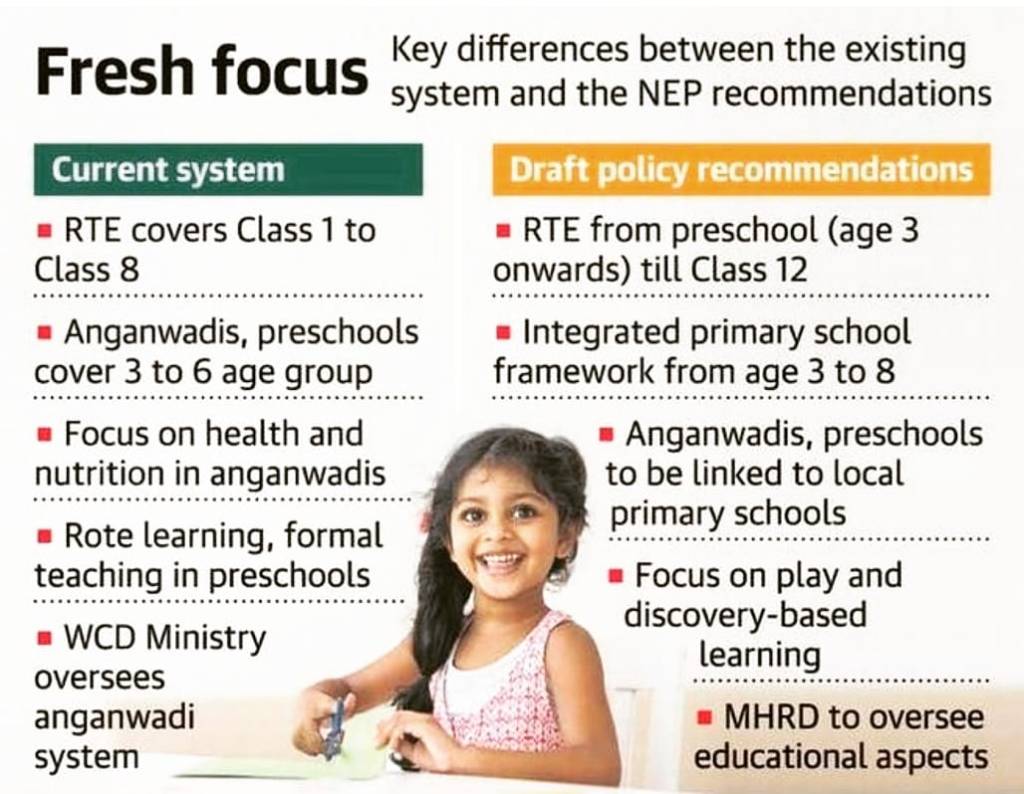
On one hand the policy talks about equitability in the field of education and on the other it transfers the responsibility of ECCE (Early Childhood Care and Education) to Anganwadi workers who are not well equipped or trained. Although the government is offering 1 year or 6 months training course to them, depending upon their previous qualification, but this is in no manner comparable with the educational qualification of a private pre-nursery teacher.
Also one of the major flaws of NEP is its sheer negligence regarding the improvement of government school infrastructure. Thus forcing the deprived to admit his child in poorly resourced government school that would focus solely on regional language; making him less compatible in job market while the rich would get his child enrolled in expensive private school that promote foreign and English language.
Although the government is working on efficient resource management in order to avoid duplication of efforts by collaborating school complexes in the same locality where resources like Labs, playgrounds, etc. could be shared commonly but the feasibility of the plan would depend upon efficient connectivity and transportation between schools.
Though NEP presents a rosy picture but the absence of realizable target, uncertainty regarding allocation of funds and the poor specification of curriculum makes it a document high on “catchwords and verbosity”. For instance, the goal of 50 percent gross enrolment ratio in higher education and 100 per cent in secondary schools while “laudable” could be tough since it was currently 25.8% in higher education.[2]
More so; while promoting vocational education; NEP fails to specify that what would happen if a student with a vocational certificate deems to apply for UG admission or would he/she be eligible to sit for one of the most eminent exam of Civil Services.
Also it seems unclear right now about how the government plans to actualize its promise of spending 6% of the GDP on education; especially at a time when it has fallen to 3.2% and the economy is already in a bad shape due to the pandemic. The goal of spending 6% is not new; it was first articulated in the 1948 Education Policy but the government was never able to achieve it. Hence now in order to ensure its implementation the government should instead make it a compulsion on all the states by articulating it as a law.
Even though allowing foreign universities in India could help in preventing brain drain but it could lead to commercialization of education by creating tough competition vis-à-vis private Indian universities if the government doesn’t come forward to incentivize it. This can be done by encouraging public collaborations and partnerships with eminent foreign universities instead of just the private ones.
Hence although the New Education Policy aims to facilitate an inclusive, participatory and holistic approach, which takes into consideration field experiences, empirical research, stakeholder feedback, as well as lessons learned from best practices; it would become a reality if and only if it is implemented and executed in a structured way.
Words like ‘’Transgender’ and talking about sexuality is considered a taboo even among the educated segment of the Indian society. Often the parents are hesitant while giving sex education and consider it as something secondary or irrelevant.
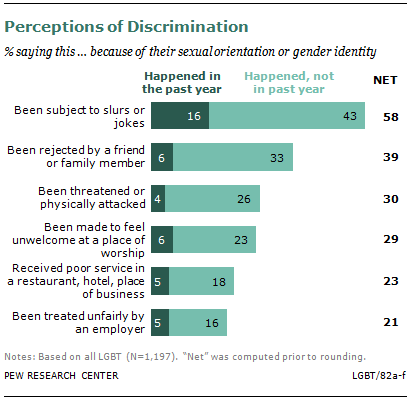
As a consequence of it, seldom had the biased and outdated information on what constituted sexual orientation and gender identity as well as stereotypical portrayal of the LGBTQ had contributed to the shaping of negative attitude and aggression towards these communities giving way to hate crimes like mob lynching.
Thus before shedding light on the aspect of why homosexuality is not a ‘mental disorder’ but a way a person perceives his own identity or why anger is rising against the LGBTQ+ or why banning same sex-marriage is a denial of their fundamental right; let us first refresh our basics and understand what does the mean?
LGBTQ is basically an acronym for lesbian, gay, bisexual, transgender and queer or questioning where:
“Lesbian” means a female who is attracted to other females.
“Gay” means people who are attracted to people of the same sex.
“Bisexual” are attracted to people of both sexes.
“Transgender” or “Trans” encompasses people whose gender identity and/or gender expression differs from what is typically associated with the sex they were assigned at birth. Transgender people may identify themselves as heterosexual, homosexual, people who are not exclusively masculine or feminine or who may decline to label their sexual orientation.
“Queer or questioning” is an individual who is unsure of and/or exploring their gender identity and/or sexual orientation.
But there is not only LGBTQ+ there are even more hues to it 😛
An “intersex” is a person born with variation in sex characteristic including chromosomes, sex hormones, or genitals.
“Asexual” or “ace” have little or no sexual attraction to others and/or a lack of interest in sexual relationships/behavior. They may or may not experience emotional, physical, or romantic attraction. Asexuality differs from celibacy in that it is a sexual orientation, not a choice.
“Pansexual” experiences sexual, romantic, physical, and/or spiritual attraction for members of all gender identities.
While people who feel that they belong to neither of the genders (M/F) or to both genders are identifed as “gender neutral,” “gender fluid”or “genderqueer”.
‘GAY’ a word that originally meant happy and carefree became a label to describe homosexuality in the 20th century and has now ended up being a term used to abuse someone. People didn’t realize the impact it could have on a person’s persona and sense of self.
If a teenager growing up gay, constantly hears the word being used to refer to something that is disliked or is embarrassing, they are quite naturally going to feel that there is something wrong with them or would start resenting others or concealing their own sexual orientation from those who have a gender identity or expression different than theirs thus creating a social divide in the society.
An Inter-Nation analysis of Countries who have passed unjust laws against LGBTQ Communities:
Despite being termed as developed there are many countries that are way too backward in their approach towards the Queer community.
For instance; Brunei, Oman and Kuwait, which are considered as developed nations have as strict punishment as death penalty, lashings or imprisonment for same-sex relationships, thus bracing and allowing bullying. In Saudi Arabia, police routinely arrests people based on their gender and sexual expressions. Malaysia and Nigeria criminalizes transgender and gender non-conforming people. In Nigeria people can be put in prison for up to 14 years just because they are gay, and some states even have death penalty under Sharia. In the United Arab Emirates, laws prohibit men “posing as” women and this law has also been used to prosecute gay and transgender people.
Even in so called world’s developed democracies; the violence and discrimination born of intolerance and marginalization continue to take lives and create barriers to equity and opportunity for LGBTQ people and their families. For instance, in 2017 the Trump administration took steps to undermine protections for LGBTQ people by repealing Obama administration’s guidance clarifying the rights of transgender students in schools. Not only this the Federal government hampered in the process to collect data on sexual orientation and gender identity in federal surveys and promoted a vision of so-called religious liberty that was misused to discriminate against LGBTQ communities. Thus often than not the fear of isolation has led many LGBT people to live in the closet, and had prompted some of them to enter heterosexual marriages. A number of them are even thrown out of their homes or cut off from financial support. Many have experienced homelessness and life at the margins of society, rendering them vulnerable to psychical and mental violence and exploitation.
The situation is barely pleasing in India where most often than not LGBTQ students face discrimination as school teachers are often not properly trained to cater to their soft impressionable minds. Also the very constitution of the recent Transgender 2019 bill, which was hastily passed in the parliament without allowing it to go through a select committee, is discriminatory in nature. For instance the bill makes it mandatory for underage Trans to live in rehabilitation centers if their immediate families are not keen to support their living. But we all are well aware about the condition and quantam of rehabilitation centers in India. Instead the bill should have made it a choice rather than making it a mandation for them.
The bill also talks about obtaining a ‘certificate of Identity’ from DM; who would issue it if he gets “Satisfied” and states that in the case of a minor, a parent/guardian has to apply for an identity certificate. This completely overlooks the reality that most parents are not supportive of gender non-conforming behavior and will, in all likelihood, not make such an application. Furthermore Gender identity is something intrinsic to one’s personhood, and can only be determined by that person’s psychological and emotional state, not by any external criteria or authority. Thus the requirement of obtaining an ‘identity certificate’ amounts to insult, indignity and humiliation at the hands of bureaucrats.
Also according to it a person committing ‘sexual abuse’ against a transgender is liable for only 2 years of imprisonment while if the victim is a cis-gender or straight then punishment is of 7 years. Hence this clause not only undermines the dignity of LGBTQ population but also encourages underreporting of cases since any punishment of less than 3 years is bailable at police station.
Economic cost of stigma against LGBTQ communities:[1]
Homophobia against Queer community not only raises humanitarian concerns but also leads to economic harm; such as potential labor time loss, lost productivity and the inefficient allocation of human resources via creating labor market stigmatization for LGBTQ people. This forces them into endless generational cycle of prostitution and begging.
A lot had already been said and argued but why is there a need for LGBTQ Marriage at all?
Quite a number of psychologists had pointed out that such stigma and prejudice may undermine the healthy development of Queer adolescents and young adults.
Also, marriage not only bestows economic and social support to these couples in committed relationships, but also results in substantial health benefit as married men and women generally experience better physical and mental health than comparable cohabiting couples.
Put simply, equality means making the same choices available to all. If Cisgender (that is, a person whose gender identity matches their sex at birth) is allowed to marry; then why not a transgender or homosexual for that matter.
Way Forward:
In order to break the stigma, LGBTQ-inclusive education in schools could be a great start. Also the parents should teach their children to accept and respect differences. For this there should be updation of school curricula to make it more gender-inclusive so that students receive accurate information from authentic sources and that too under proper guidance.
Apart from this the school authorities can invite experts to give practical information on safe copulation, engage open conversations on identity, relationships and mental health with both parents and children. Apart from this teachers can be provided training sessions on a regular interval so that they are better able to handle the situation in case a child confides with them to seek help. Every school should appoint atleast one counselor or psychologist so that the student can easily seek help if required.
Also reservations in education and employment sector can play a prominent role in ensuring financial independence of the Trans community; thus allowing them to move hand in hand with the mainstream population. For instance the creation of ‘Gender Inclusion Fund’, which seeks to ensure equitable education for all girls and transgender students; under the recent National Educational Policy (NEP) 2020 is a laudable initiative. But still the road is long and a lot is to be done.
Although the equal marriage legislation passed by the Indian government suggests that society had advanced in its thinking, but there still remains a gap in its grasp of gay identity, culture and sexuality. Laws would just remain a document on paper till the time we are not able to transform the core beliefs, sentiments and ideas of the people itself. Hence nations need to adopt a more inclusive – gender holistic approach via recognizing the LGBTQ community. And until the approach towards them changes, young people will continue to grow up feeling that the word “gay” means alien, embarrassing or has something wrong associated with it.
The ongoing public health emergency has made it more obvious than ever that housing and health are intrinsically interlinked. Housing is a social determinant of health, but it is rarely considered while formulating the public health policies (PSAs). However in times like today when we are advised to stay at home in a quarantine or self-isolate ourselves due to the paucity in the number of beds in the hospital, it becomes evident that proper housing is an essential determinant in our health setting, and one cannot enjoy their right to health without being assured of safe housing.
Living without a home, rough sleeping or staying in temporary accommodation makes the destitute and homeless prone to contagious disease as they face a number of barriers in accessing appropriate health care and public health information. Due to their compromised immune systems, poor nutrition and hygiene and long-term residence in overcrowded shelters they are at a higher risk of contamination.
For instance, a recent US based study documented that there was deliberate recruitment of homeless people into dangerous pharmaceutical drug trials. Private companies who run drug studies may coerce penniless people with payments of up to thousands of dollars.
The crisis is specially affecting the homeless women as they are often denied personal health care services like pads, proper washrooms, etc. Also they become completely subservient to government officials for food supplies and for ensuring the very basic hygiene facilities.
Amidst all this, it becomes almost impossible for the homeless population of the country to adhere to government guidelines of self-isolation, maintaining more hygiene, staying at home, and strict social distancing, disarranging them from the public policy responses to the pandemic. This serves as a classic example of the fact that formulation of policies for the destitute without their consent can lead to their utter failure and ruckus.
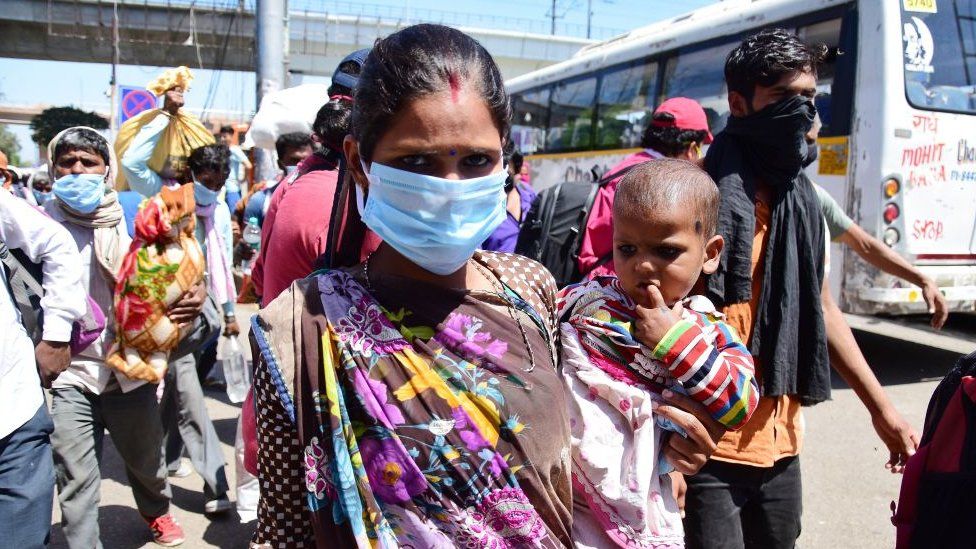
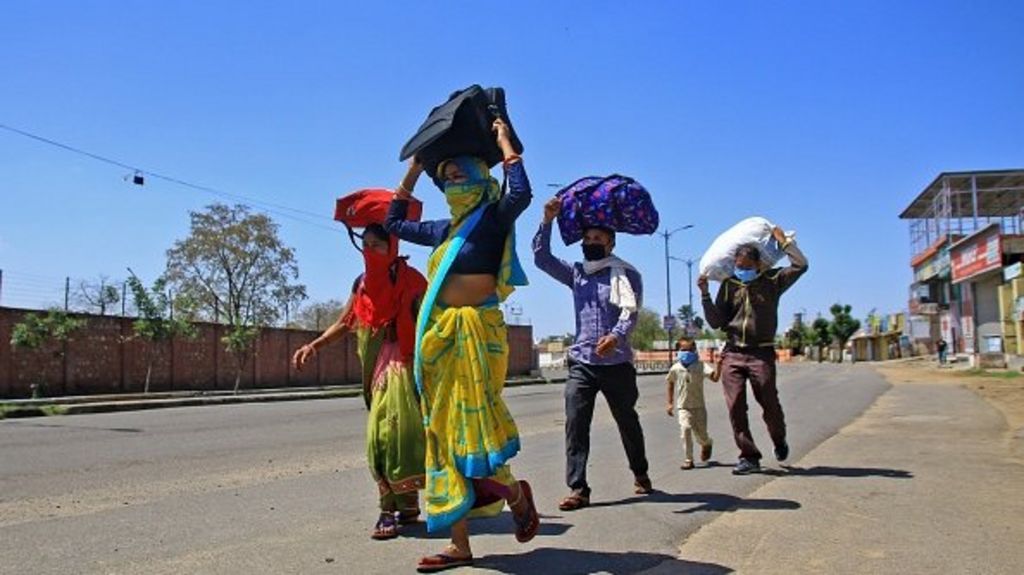
The nationwide lock down, announced by the Prime Minister which resulted in the sudden shutdown of businesses; upended the lives of millions of migrant laborers and homeless in the Indian cities.They were bound by a collective will to somehow get back to where they belong. Since for them home in the village ensures both food and social security of the family.
Among the teeming refugees of the lock down was a 90-year-old woman, whose family sold cheap toys at traffic lights in a suburb outside Delhi. She and her family ate biscuits and smoked beedis, to kill hunger. Upon inquiry she said, “We will die of walking and hunger before corona virus hits us,” surely she was not exaggerating. Last week during the month of march, a 39-year-old man on a 300km (186 miles) trek from Delhi to Madhya Pradesh complained of chest pain and exhaustion and died; and a 62-year-old man, returning from a hospital by foot in Gujarat, collapsed outside his house and died. Four other migrants, turned away at the borders on their way to Rajasthan from Gujarat where they were mowed down by a truck on a dark highway.
The staggering exodus was reminiscent of the flight of refugees during the bloody partition in 1947. Clearly, a lockdown to stave off a pandemic is turning into a humanitarian crisis.
Also amidst the corona virus pandemic, cases pertaining to domestic and sexual abuse are on a rise. A few days back, a horrifying incident took place in Bihar where a migrant woman who was suspected of Covid-19, was sexually abused in Gaya hospital where she was kept in an isolation ward. Three days later, she died due to excessive bleeding. Incidents like these questions the safety norms at these places.
Core priorities right now should include active case-finding through testing; providing access to emergency housing that is fit for isolation purposes; making existing shelters safe places for homeless people to stay; and treatment programmes.
Support for homeless people should not only include those experiencing homelessness but also be concerned with protecting those vulnerably housed who are at a higher risk of homelessness because of the economic impact of COVID-19 outbreak.
India can learn from other’s example; for instance Mortgage holidays have been announced in several countries; measures similar to these can be announced for renters, who are often more vulnerable in the short term. Specific measures targeting the insecurely housed are needed, such as a moratorium on evictions to stop people losing their housing during the pandemic.
The current pandemic clearly highlights the division among-st India’s population; on one hand there is a segment that has the window to strike plates and light divas from the vicinity of their safe homes; and on the other hand there is a segment that is determined to reach home even if it had to walk 1000s of miles barefoot. On one hand flights had been launched to bring back nationals and on the other the destitute was forced to stay in overcrowded temporary accommodation without the provision of even the bare facilities. In these trying times there is also an urgent need for the states to adhere to strict measures in order to curb the transmission from this high-risk migrant population to their hometown.
Homelessness must be considered a public health priority. A public health emergency requires emergency solutions and crisis management, and there are such initiatives including making vacant housing and hotels available for homeless people to self-isolate with adequate number of experienced doctors. The current crisis clearly show that shelters cannot replace the safe homes that are indispensable for a healthy life for all.
With this thought I Srishti Jain would be signing off 🙂
The ongoing public health emergency has made it more obvious than ever that housing and health are intrinsically interlinked. Housing is a social determinant of health, but it is rarely considered while formulating health policies. However, in times like today when we are advised to stay at home in quarantine or self-isolate ourselves due to the paucity in the number of beds in the hospital, it becomes evident that proper housing is an essential determinant in our health setting, and one cannot enjoy their right to health without a safe home. Living without a home, rough sleeping, or staying in temporary accommodation makes the destitute and homeless prone to contagious disease as they face a number of barriers in accessing appropriate health care and public health information. Due to their compromised immune systems, poor nutrition and hygiene, and long-term residence in overcrowded shelters they are at a higher risk of contamination. For instance, a recent US-based study documented that there was deliberate recruitment of homeless people into dangerous pharmaceutical drug trials. Private companies who run drug studies may coerce penniless people with payments of up to thousands of dollars. The crisis is especially affecting homeless women as they are often denied personal health care services like pads, proper washrooms, etc. Also, they become completely subservient to government officials for food supplies and basic hygiene facilities. Amidst all this, it becomes almost impossible for the homeless population of the country to adhere to government guidelines of self-isolation, maintaining more hygiene, staying at home, and strict social distancing, disarranging them from the public policy responses to the pandemic. Formulation of policies for the destitute without their consent can lead to their utter failure and ruckus. The nationwide lockdown, announced by the P.M, resulted in the sudden shutdown of businesses which upended the lives of millions of migrant laborers and homeless in the Indian cities. They were bound by a collective will to somehow get back to where they belong. Since for them home in the village ensures both food and social security of the family. Among the teeming refugees of the lockdown was a 90-year-old woman, whose family sold cheap toys at traffic lights in a suburb outside Delhi. She and her family ate biscuits and smoked ‘beedis’, to kill hunger. She said, “We will die of walking and hunger before the virus actually hits us,” surely she was not exaggerating. Last week during the month of March, a 39-year-old man on a 300km (186 miles) trek from Delhi to Madhya Pradesh complained of chest pain and exhaustion and died; and a 62-year-old man, returning from a hospital by foot in Gujarat, collapsed outside his house and died. Four other migrants, turned away at the borders on their way to Rajasthan from Gujarat, were mowed down by a truck on a dark highway. The staggering exodus was reminiscent of the plight of refugees during the bloody partition in 1947. Clearly, a lockdown to stave off a pandemic is turning into a humanitarian crisis. States should adhere to strict measures in order to curb the transmission from this high-risk migrant population to their hometown. Also amidst the coronavirus pandemic, cases pertaining to domestic and sexual abuse are on a rise. A few days back, a horrifying incident took place in Bihar where a migrant woman who was suspected of Covid-19, was sexually abused in Gaya hospital where she was kept in an isolation ward. Three days later, she died due to excessive bleeding. Incidents like these question the safety norms at these places. Core priorities right now should include active case-finding through testing; providing access to emergency housing that is fit for isolation purposes; making existing shelters safe places for homeless people to stay; and treatment programs. Support for homeless people should not only include those experiencing homelessness but also be concerned with protecting those vulnerably housed who are at a higher risk of homelessness because of the economic impact of the COVID-19 outbreak. Mortgage holidays have been announced in several countries. Similar measures for renters, who are often more vulnerable in the short term, ought to be processed by the states. Specific measures targeting the insecurely housed are needed, such as a moratorium on evictions to stop people from losing their housing during the pandemic. Homelessness must be considered a public health priority. A public health emergency requires emergency solutions and crisis management, and there are such initiatives including making vacant housing and hotels available for homeless people to self-isolate. However, it is also an opportunity to reconsider policies that are not working and to shift to long-term thinking. The current crisis clearly shows that shelters cannot replace the safe homes that are indispensable for a healthy life for all.



 Quintessentially Humanistic@myblog.com