In its 2014 manifesto; the government had elaborated in detail its plan for higher educational institutions, skill education, employ-ability and establishing closer links between the private and public educational sector.
The new National Education Policy approved on July 29, 2020; after a 34-year gap, showcases an ideal framework for India’s education system and seeks to transform it by 2040. It is the third Education Policy after independence and was preceded by the 1968 policy which was heavily influenced by the progressive Kothari commission of 1964-66 and the 1986 policy. This 65-page document recommends steps for different sectors of education to “overhaul” and “revamp” education in our country.
For instance its mandate of phasing out ‘para-teachers’ contract that is hiring teachers on a short term basis and the elimination of unnecessary transfers would enable stability by helping in strengthening long term student-teacher relationship.
Also the policy seeks to bring 2 crore out of school children back into the mainstream through an open schooling system but it no where mentions about creating the proper means to do so. The dream seems even fader while considering India’s digital divide and keeping in mind the recent statistics by ‘The Hindu’[1] that only 24% of Indians own a smart phone.
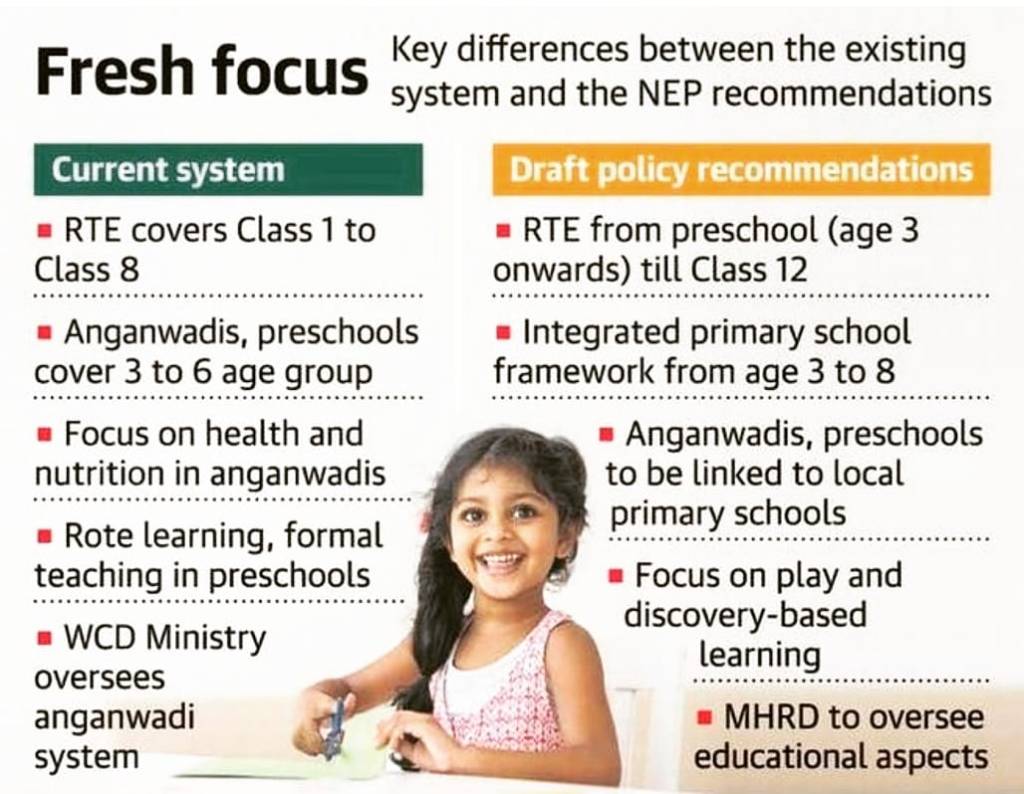
On one hand the policy talks about equitability in the field of education and on the other it transfers the responsibility of ECCE (Early Childhood Care and Education) to Anganwadi workers who are not well equipped or trained. Although the government is offering 1 year or 6 months training course to them, depending upon their previous qualification, but this is in no manner comparable with the educational qualification of a private pre-nursery teacher.
Also one of the major flaws of NEP is its sheer negligence regarding the improvement of government school infrastructure. Thus forcing the deprived to admit his child in poorly resourced government school that would focus solely on regional language; making him less compatible in job market while the rich would get his child enrolled in expensive private school that promote foreign and English language.
Although the government is working on efficient resource management in order to avoid duplication of efforts by collaborating school complexes in the same locality where resources like Labs, playgrounds, etc. could be shared commonly but the feasibility of the plan would depend upon efficient connectivity and transportation between schools.
Though NEP presents a rosy picture but the absence of realizable target, uncertainty regarding allocation of funds and the poor specification of curriculum makes it a document high on “catchwords and verbosity”. For instance, the goal of 50 percent gross enrolment ratio in higher education and 100 per cent in secondary schools while “laudable” could be tough since it was currently 25.8% in higher education.[2]
More so; while promoting vocational education; NEP fails to specify that what would happen if a student with a vocational certificate deems to apply for UG admission or would he/she be eligible to sit for one of the most eminent exam of Civil Services.
Also it seems unclear right now about how the government plans to actualize its promise of spending 6% of the GDP on education; especially at a time when it has fallen to 3.2% and the economy is already in a bad shape due to the pandemic. The goal of spending 6% is not new; it was first articulated in the 1948 Education Policy but the government was never able to achieve it. Hence now in order to ensure its implementation the government should instead make it a compulsion on all the states by articulating it as a law.
Even though allowing foreign universities in India could help in preventing brain drain but it could lead to commercialization of education by creating tough competition vis-à-vis private Indian universities if the government doesn’t come forward to incentivize it. This can be done by encouraging public collaborations and partnerships with eminent foreign universities instead of just the private ones.
Hence although the New Education Policy aims to facilitate an inclusive, participatory and holistic approach, which takes into consideration field experiences, empirical research, stakeholder feedback, as well as lessons learned from best practices; it would become a reality if and only if it is implemented and executed in a structured way.
[1] https://www.thehindu.com/news/national/24-pc-of-indians-have-a-smartphone/article26212864.ece
[2] https://www.pressreader.com/india/the-hindu/20200731/282029034561933

 Quintessentially Humanistic@myblog.com